In the fish processing industry, back-opening and deboning equipment is a key tool for improving efficiency.
This type of equipment replaces traditional manual operations with automation technology, completing processes such as back-opening, deboning, and slicing fish.
It is suitable for various types of fish, including basa, tilapia, salmon, mackerel, and eel, and is especially suitable for processing fish weighing 200-2000 grams and measuring 10-20 cm in height.
Its core value lies in standardized processing procedures, reducing human error, and increasing output per unit time to 20-60 fish per minute.
Fish Back Opening Machine Technology Principle and Core Structure:
The equipment is electrically driven, with a rated power of 1.5KW and a voltage of 380V. The movement trajectory of the cutters is controlled through a mechanical transmission system.
Its core components include an adjustable blade assembly, a fish bone separation module, and a discharge conveyor.
The blade assembly design supports multi-angle cutting, enabling the processing of different shapes such as butterfly slices and back-opened slices.
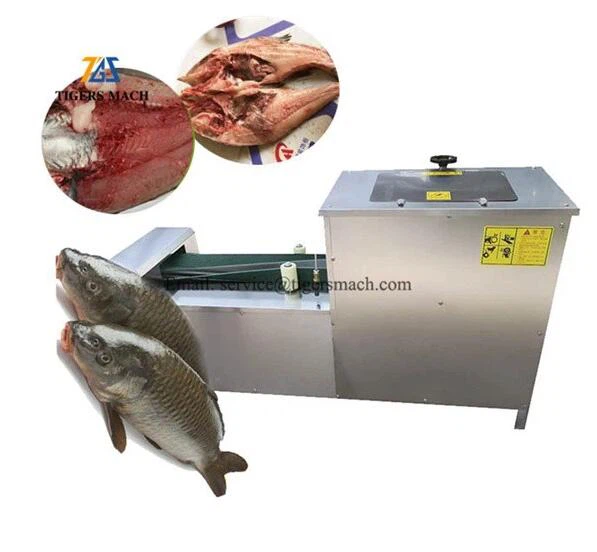
The fishbone separation module uses biomimetic principles to simulate manual deboning, reducing fish meat damage.
The discharge port features a large-capacity design, coupled with visual indicator lights to show processing status and prevent material accumulation.
Safety and Operation Design:
The Fish Back Opening Machine is equipped with multiple safety protection mechanisms: a transparent viewing window allows real-time observation of the processing process while preventing operators from contacting moving parts.
A one-button emergency stop is located in a prominent position on the top of the machine, allowing immediate shutdown in case of abnormalities. The fishbone and fish meat discharge ports are separate to avoid cross-contamination.
The operation process is simplified to three steps: place the fish, start the machine, and collect the finished product; no professional training is required to operate it.
Compared to traditional equipment, this model offers significant improvements in compatibility and efficiency. Its blade spacing is adjustable to accommodate fish of varying thicknesses.
It supports customized processing, allowing adjustment of cutting parameters for specific fish species.
Suitable for central kitchens, seafood processing plants, chain restaurant kitchens, and other scenarios, especially suitable for commercial users requiring batch processing of standardized fish fillets.